SEO for job boards: the complete 2026 guide

Job board SEO is different from normal website SEO, and mostly in your favor. A job board generates hundreds or thousands of pages automatically (every listing, every category, every location), each one targeting a query someone actually types. The catch: Google has specific, strict expectations for job content, and boards that ignore them are invisible while boards that meet them get a firehose of free candidate traffic.
This guide covers the whole stack: structured data, indexing speed, site architecture, expired-job hygiene, duplicate-content traps, and the content layer on top. It applies whatever software you run; where easyboard automates a step, we say so.
Why job boards are SEO machines
Three structural advantages, all compounding:
- Programmatic long tail. Nobody hand-writes a page for "senior electrician jobs in Tulsa", but a board with jobs, categories, and locations generates it automatically, and that query has almost no serious competition.
- Freshness by default. New jobs arrive daily, which means fresh content and frequent crawls without an editorial calendar.
- Google for Jobs. Google maintains a dedicated jobs experience at the top of results and fills it from structured data on job pages. It is the single largest organic channel for most boards, and eligibility is purely technical.
Google for Jobs and JobPosting structured data
Google for Jobs reads JobPosting structured data (JSON-LD) embedded in each listing page. To be eligible, every job page needs valid markup with, at minimum: title, description (full HTML, not a summary), datePosted, validThrough, hiringOrganization, and jobLocation. Remote roles additionally need applicantLocationRequirements and jobLocationType to show up in "work from home" searches; salary (baseSalary) is optional but strongly rewarded with better placement and more clicks.
The rules that trip boards up:
- The markup must match the visible page. A salary in the JSON-LD that is not on the page is a violation.
- One job, one page. List pages must not carry JobPosting markup, only detail pages.
- Expired means gone. Once validThrough passes, the markup must disappear or the page must 404/410. Stale postings are the most common cause of a Google for Jobs penalty (a "manual action" that drops your whole board from the jobs experience).
Validate with Google's Rich Results Test on a handful of live listings. If your platform emits the markup automatically, spot-check it anyway after any redesign.
Get indexed in hours, not weeks: sitemaps and the Indexing API
Job postings have short lives, so indexing speed decides how much of a job's traffic you actually receive. Three mechanisms, in escalating power:
- XML sitemaps with accurate lastmod values, split by content type (jobs, categories, content pages), submitted in Search Console.
- Crawl-friendly internal linking: every new job reachable within two clicks of the homepage (latest-jobs blocks, category pages).
- The Google Indexing API: Google's push channel, officially reserved for exactly two content types, and job postings are one of them. Pinging it on publish and on expiry gets listings indexed (and de-indexed) in hours instead of days. This is the single highest-leverage technical feature a job board can have.
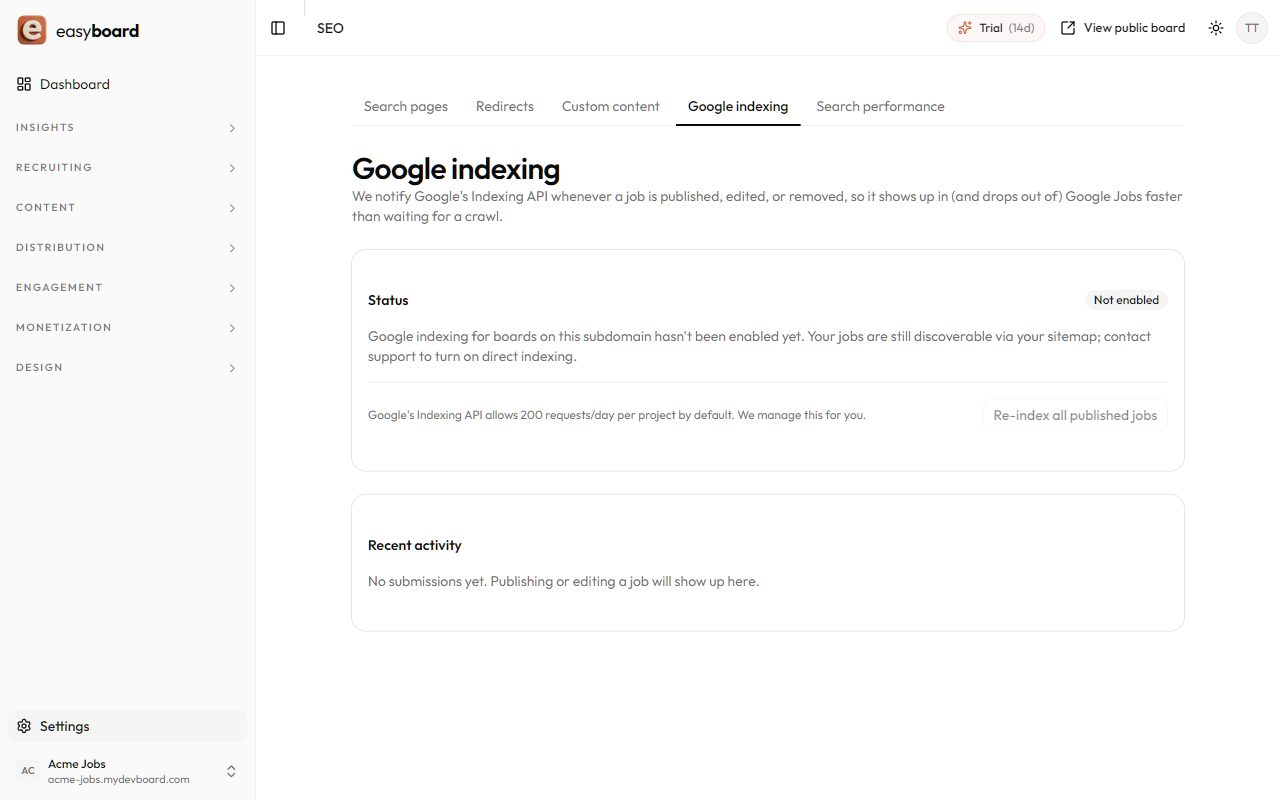
easyboard pings the Indexing API automatically on publish and expiry once a board connects its Google account (a five-minute, in-dashboard flow), and maintains the split sitemaps for you.
Search pages: the architecture that ranks
Individual listings expire; search pages persist. The durable SEO asset of a job board is its set of category, location, and category-x-location pages: "warehouse jobs in Leeds", "remote nurse jobs", "junior developer jobs". These pages accumulate age, links, and rankings while the jobs inside them rotate.
Doing them well means:
- Clean, crawlable URLs (/remote-nurse-jobs, not /search?q=nurse&remote=1), each with a unique title, meta description, and an H1 that names the query.
- A sentence or two of indexable copy on each page (what the category is, typical salaries, top employers), so the page is not a bare listing grid.
- Curation over combinatorics. Generate pages for combinations with real inventory and real search volume; noindex or skip empty ones. Ten thousand thin pages hurt more than a hundred strong ones help.
- Interlinking: each job links to its category and location pages; category pages link to sibling and child pages.
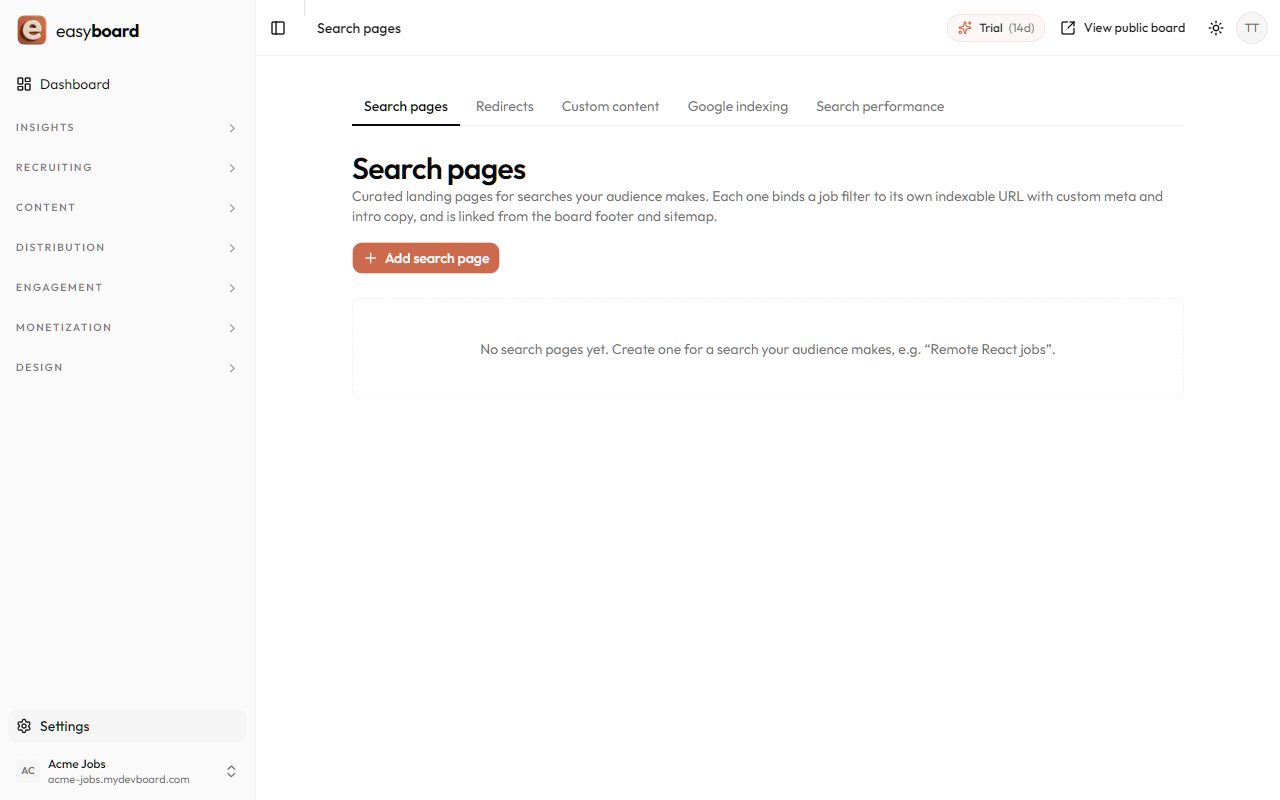
In easyboard these are the curated SEO search pages: you define the combinations worth ranking for, the platform generates the pages, copy blocks, and interlinks, and keeps them out of the index when they would be empty.
Expired jobs: the hygiene that protects everything else
What happens when a job ends decides both your rankings and your penalty risk:
- Return 404 or 410 for expired listings (or keep the page with markup removed and an "expired" notice pointing to similar live jobs; both are compliant, the redirect-everything-to-homepage pattern is not).
- Update the sitemap and ping the Indexing API on expiry so Google stops sending applicants to dead pages.
- Never recycle URLs between different jobs; every posting gets its own permanent URL.
Duplicate content: the aggregation question
Most boards backfill with aggregated jobs (see why launching empty is worse and where imported jobs come from), which means descriptions that also exist elsewhere. Google handles syndicated job content routinely; what matters is adding value around it: your own category copy, salary context, company pages, and a clean apply path. Boards get into trouble when the entire site is verbatim duplicates with zero original surface, not when listings are honestly syndicated. Set canonical tags on your own pages (never canonical to the source), and invest your original-content effort where it compounds: search pages and editorial.
The content layer: queries jobs can't catch
Candidates search long before they apply: "how to become a wind turbine technician", "electrician apprentice salary", "best companies for remote nurses". Listings cannot rank for these; articles can, and they feed the board via internal links and job alerts.
The formats that work for boards, in rough priority order:
- Salary guides for the niche's core roles (update yearly, they become link magnets).
- "How to become a [role]" career paths, the top-of-funnel evergreen.
- "Top companies hiring [niche] in [year]" roundups, which employers share themselves.
- Interview and certification guides specific to the niche.
Every article should end where the reader wants to go next: the relevant search page and a job-alert signup.
Technical basics that still matter
- Speed and mobile: most candidate traffic is mobile; a slow board loses both users and crawl budget.
- HTTPS on your own domain: run the board on a domain you own, not a platform subdomain, so every backlink builds your asset (and survives a platform switch).
- robots.txt and noindex discipline: keep faceted-search permutations, empty pages, and admin routes out of the index.
- An RSS or XML feed of new jobs, which niche aggregators and newsletters will pick up, each pickup a fresh crawl signal.
Measure it in Search Console
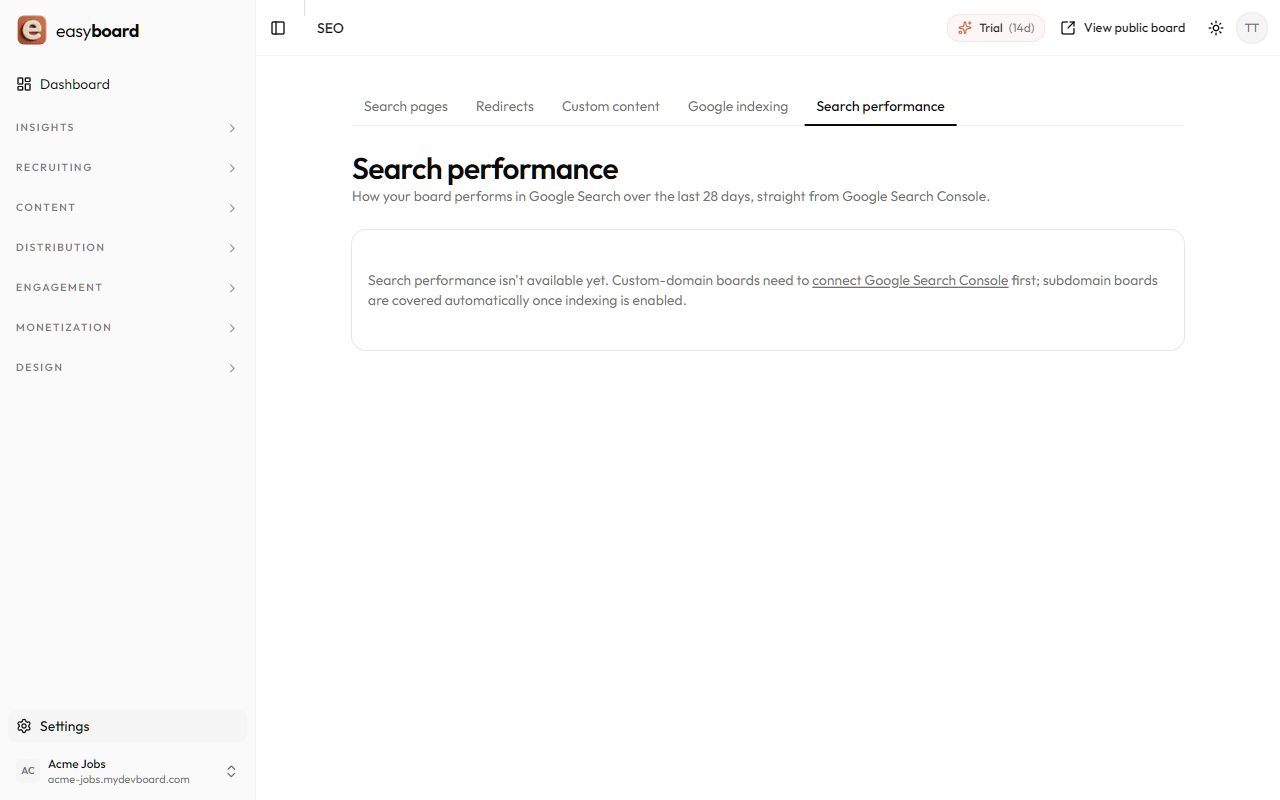
Google Search Console is the only scoreboard that matters early on: verify the property, submit the sitemaps, then watch three things weekly. Impressions on search pages (is the architecture ranking?), clicks on job detail pages (is Google for Jobs sending traffic?), and the Coverage report (are expired jobs leaving the index promptly?). Pair it with on-board analytics (views to applies per source) to see which channel produces applicants, not just visits.
How easyboard handles this out of the box
Everything above that can be automated, is: valid JobPosting markup with the visible-content match, remote and salary fields included; automatic Indexing API pings on publish and expiry; split sitemaps with lastmod; curated search pages with copy blocks and interlinking; correct 404/410 expiry behavior; per-page SEO overrides; a built-in blog for the content layer; and Search Console verification from the dashboard. The point of the platform is that "job board SEO checklist" becomes "write good category copy and publish good content", which is the part only you can do.
If you are still choosing software, the SEO column is the one to compare hardest: Best job board software in 2026 scores the main platforms on exactly this.
Frequently asked questions
How do job boards rank on Google?
Through three layers: JobPosting structured data that gets every listing into Google for Jobs, durable category and location search pages that rank for "[role] jobs in [place]" queries, and editorial content for career-stage queries. Fast indexing (sitemaps plus the Indexing API) multiplies all three because job postings are short-lived.
What is Google for Jobs and how do I get listed?
Google for Jobs is the dedicated jobs experience at the top of Google results, filled from JobPosting structured data on job pages. To appear, each listing page needs valid, complete markup that matches the visible content, and expired jobs must be removed promptly. There is no submission process and no fee; eligibility is purely technical.
Do aggregated or backfilled jobs hurt SEO?
Not inherently. Google handles syndicated job content routinely. Problems arise when a site is nothing but verbatim duplicates with no original value around them. Add your own search-page copy, salary context, and editorial layer, keep canonicals pointing at your own pages, and backfill helps SEO (more inventory, more pages, more freshness) rather than hurting it.
How long does job board SEO take?
Google for Jobs traffic can start within days of valid markup and Indexing API pings. Search pages typically take 3 to 6 months to rank for long-tail queries and 6 to 12 for competitive ones. Editorial content compounds over the first year. The sequence matters: technical eligibility first, architecture second, content third.
Should expired job postings be deleted or redirected?
Either return 404/410, or keep the page live with the JobPosting markup removed, an expired notice, and links to similar live jobs. Do not blanket-redirect expired jobs to the homepage, and never leave expired markup up: stale postings are the most common trigger for Google for Jobs penalties.
Keep reading